Does Israel's religious right really want a Holy War with a billion Muslims?
The rising power of extremism in Israel should worry us all not least the country itself

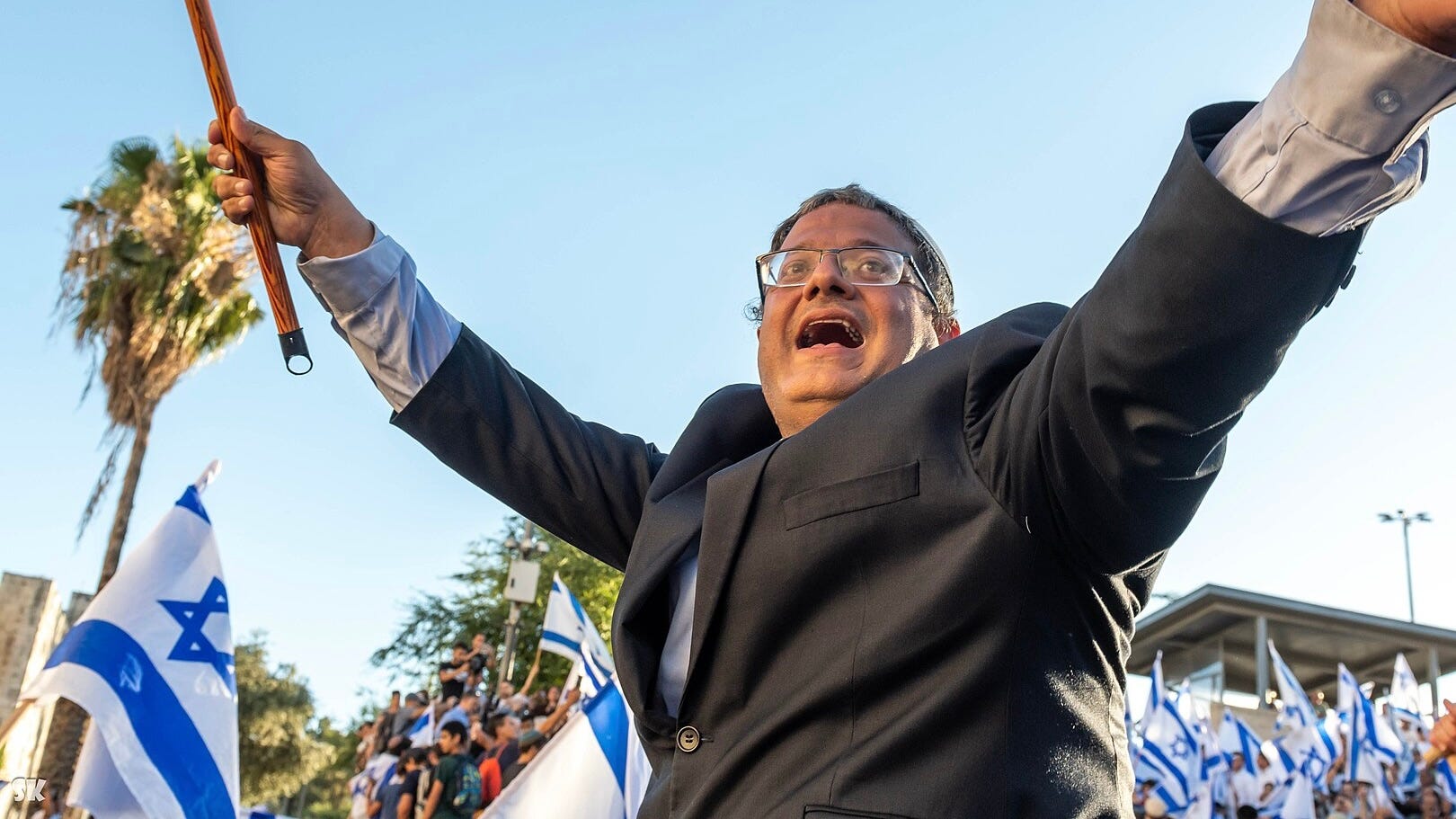
Does Israel’s right wing want to start a Holy War with Islam? And do they understand what that would mean for Israel, for the region and the world?
The question is not alarmist. Nor is it partisan. It’s not an ‘anti-Israeli’ or a ‘pro-Palestinian’ question. It’s a serious geopolitical question Western governments should be asking themselves. The possible answers are alarming.
Escorted by armed police, Israel’s far-right minister of national security, Itamar Ben-Gvir, joined thousands of Jewish extremists who flooded into the Temple Mount compound, Jerusalem’s most sensitive holy site shared by Muslims, Jews and Christians, this week.
They prayed, waved the Israeli flag and sang the national anthem in a highly charged, provocative display of political power. It’s not the first time.
Emboldened by Israel’s overwhelming military force displayed with pitiless consistency across the region since October 7, 2023 the Israeli right - now part of the governing coalition - believes itself to be untouchable.
The use of the phrase Holy War is not a metaphor. It is a stated goal for the religious right without whose support Prime Minister Benyamin Netanyahu’s coalition would collapse.
For that faction, led by Ben-Gvir, the storming of the holy sites in Jerusalem are not tactics. Ben-Gvir is not a fringe protester. He represents the state of Israel.
And these are not occasional weekend protests such as we see at Speaker’s Corner in London’s Hyde Park. They are carefully organised steps toward a strategic and theological endpoint.
They believe they are doing God's work. That work involves at its core, the establishment of an exclusively religious, Jewish state from the river Jordan to the Mediterranean sea - Eretz Israel.
This moment in history, over the bodies of 70,000 dead Palestinians in Gaza and growing settler violence on the West Bank, is the moment that will lead to the final era of a united Jewish kingdom. Such moments will spark divine redemption (Guelah).
And like all extremists, Ben-Gvir and his fellow travellers are indifferent to the geopolitical consequences of their actions and their goals. This is something that should terrify everyone else.
Just so we understand the gravity of what’s occurring here is an analogy:
Imagine a serving minister in a European government, who happens to be a Muslim, leading thousands of supporters into St Peter's Basilica in Rome under armed escort.
They perform Islamic prayers at the high altar, wave the Palestinian national flag, sing their national anthem Feda’i which means warrior. The Pope watches, powerless. This happens repeatedly.
It has happened before - but not in times like these. America and Israel are at war with Iran, the world economy is hostage to the Revolutionary Guard’s hold over the Straits of Hormuz and a growing number of young Muslims around the world are being radicalised.
In 1969, an Australian Christian fundamentalist set fire to the Al-Aqsa mosque, the main Muslim congregational prayer hall in the compound. Riots erupted across the Muslim world from Morocco to Indonesia.
In 2000, the late Ariel Sharon, the general and later Israeli Prime Minister, visited the Temple Mount with a heavy security escort. That visit and what it symbolised is widely credited with triggering the Second Intifada, or Palestinian uprising, which killed over four thousand people.
The deeper historical precedent of course is the Crusades: centuries of catastrophic violence, rooted in competing claims to the same few acres of Jerusalem.
The memory of that period remains vivid in the Islamic mind in a way that the West consistently underestimates.
What could this fanatical behaviour lead to if it’s allowed to run?
At a minimum: the collapse of any prospect of Saudi normalisation with Israel, the end of the Abraham Accords as a meaningful framework, and the empowerment of Iran and its proxies. In other words shattering and prospect of peace in the Middle East for another generation.
Jordan, whose peace treaty with Israel is partly premised on Hashemite custodianship of the holy sites, would face an impossible position.
Saudi Arabia’s position is critical. The Saudi king holds the title Custodian of the Two Holy Mosques. Al-Aqsa is Islam’s third holiest site. If it were seriously desecrated — or if the attempt to change the status quo became undeniable — no Saudi ruler could remain silent without risking his domestic legitimacy.
Saudi Arabia may be an autocracy but the King rules by consent of the descendants of the Sudairy Seven - the seven brothers, sons of the kingdom’s founder Ibn Saud. They in turn rely on the support of tribal leaders.
The pressure from the Muslim world would be enormous. Iran, which has been trying to position itself as the true defender of Palestinian and Islamic interests, would exploit it.
Every proxy from Hezbollah to the Houthis would have a new and powerful recruitment narrative.
What could follow is a regional war framed in explicitly religious terms, which, as we know, is the hardest kind of war to end.
The Israeli security establishment shares this fear. Shin Bet, the IDF, Mossad have all warned that altering the status quo at Al-Aqsa is the most reliable way to spark a regional war.
Ben-Gvir doesn’t believe them or doesn't care. He appears to welcome it.
Religious fanatics believe they are answerable only to God. Ultra-orthodox religious Jews believe history vindicates them. Such people become, as we have seen with the Taliban and ISIS, immune to reason or even self-interest.
Muslims carry a shared narrative with Jews: the return of a golden age when Islam ruled the world. Islam is the fastest growing religion in the world. But there are many more of them- two billion. It has no equivalent.
Islam also shares many characteristics with Judaism: It’s a faith, an identity, a legal framework, a global solidarity movement and a potent political force. It would be a great mistake to underestimate its reach.
Israel’s feelings of vulnerability are not without cause. The massacre on October 7 poured fuel on the flame. Israel believes that only through the force of arms can it survive. That is understandable but misguided.
A country that mistakes military superiority for permanent security has confused the means with the end.
Israel has the finest army in the region, nuclear weapons it will not officially acknowledge, and the unconditional backing of the world's most powerful nation.
In the long-run none of that will protect it if it succeeds in uniting two billion people against it.